A driveway lasts as long as the ground under it.
Most driveway failures start below the concrete. Water sits in a soft spot, freezes, lifts the slab, and a crack shows up the next spring. So the work starts with digging out the old surface and the soft soil, grading so water runs away from the house and the garage, and compacting a gravel base until it stops moving. That base is what the slab rests on for the next few decades, and it is the step that gets rushed most often.
Then come the forms, set to grade, and the steel: rebar or wire mesh, depending on the job. Control joints go in at the right spacing so that when concrete does crack, it cracks in a straight line inside a joint instead of across the middle of the drive. Outdoor concrete in Michigan should be an air-entrained mix, since the tiny air pockets give freezing water room to expand. It is a fair question to ask anyone who quotes your driveway.
After the pour comes the cure. You can walk on it after about a day, but give it a full seven days before a car or truck goes on it. Keep road salt and deicers off it through its first winter, since new concrete is at its most vulnerable then. If the driveway meets a county road or a city street, the approach where it ties in usually needs a permit from whoever owns that road, and we can help you sort out which office that is.
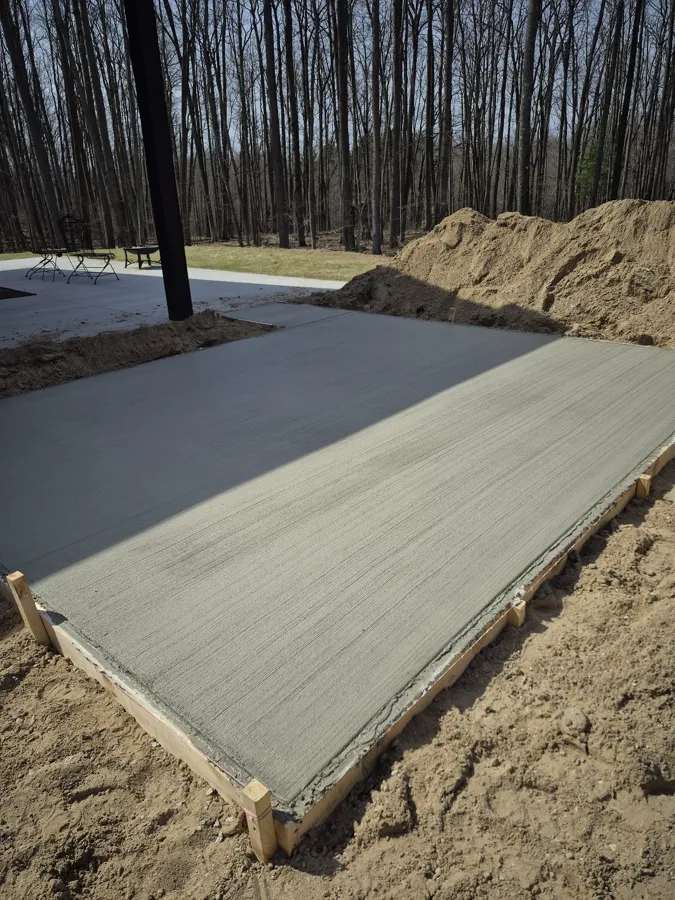
What goes into one of our driveways
- Old surface and soft soil dug out, not paved over
- Grade set so water runs away from the house and garage
- Compacted gravel base, the part that keeps it flat
- Rebar or wire mesh, matched to the job
- Control joints cut at the right spacing
- Broom finish for grip in rain and snow
